I was kneeling in the dust of a site near Ostia last autumn, my knees aching against the uneven ground, when I saw it again—that same, frustratingly vague explanation in a textbook about how Roman concrete was made. They always talk about it as if it were some mystical, lost alchemy, a magic recipe that vanished into the ether. It’s nonsense. When you actually get your hands dirty and look at the stratigraphy of a wall, you realize it wasn’t magic; it was a series of very deliberate, very physical choices made by people who understood their materials better than we do today.
I am not here to feed you the romanticized myths or the dry, academic jargon that makes your eyes glaze over. Instead, I want to show you the mechanical reality of the material. We are going to look past the grand facades and focus on the aggregate, the lime, and the volcanic ash to understand exactly how Roman concrete was made through the lens of a practitioner. I’ll show you how to read the decisions left behind in the mortar, so you can finally see the human hand behind the stone.
Table of Contents
The Volcanic Ash Reaction Within the Mix
When I’m on-site, I often find myself running my fingers over a fractured surface, trying to trace the chemistry of the past. The real magic isn’t just in the recipe, but in the volcanic ash reaction that occurs long after the mortar has set. Unlike modern Portland cement, which is designed to be inert and static, the Roman mix is essentially alive. When the pozzolana—that fine, reddish-grey volcanic dust—meets the lime, it initiates a slow, crystalline growth. You aren’t just looking at a hardened paste; you are looking at a complex web of mineral structures that continue to knit themselves together over centuries.
This is where the true genius of ancient Roman construction techniques reveals itself. As micro-cracks inevitably form due to thermal expansion or settling, moisture seeps into the tiny fissures. This water reacts with the residual unreacted material within the matrix, triggering a chemical rebirth that fills the gap. It is these self-healing concrete properties that allow a pier in the Tyrrhenian Sea to remain standing while our modern reinforced structures crumble under salt spray. To me, a crack isn’t just a sign of decay; it’s an invitation to see how the building is still trying to fix itself.
Deciphering Ancient Roman Construction Techniques
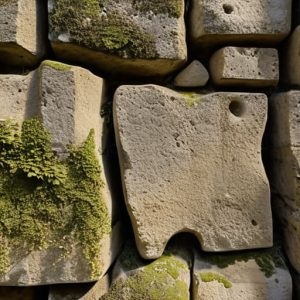
When I am on a site, I find myself tracing the edges where the aggregate meets the binder, looking for the ghost of a decision. It isn’t enough to simply know that they used lime; you have to see how they layered it. In many of the structures I’ve surveyed, you can observe the intentionality behind ancient Roman construction techniques by looking at the density of the pour. They weren’t just dumping material into a mold; they were managing a chemical evolution. You can almost feel the tension in the way they packed the caementa—those hand-sized chunks of stone—into the mortar to ensure there were no structural voids left to the whims of time.
What fascinates me most, and what I often capture in my sketches, is the way these materials respond to their environment centuries later. If you examine a weathered pier near the coast, you aren’t just looking at decay; you are looking at maritime concrete durability in action. The seawater actually triggers a secondary reaction within the matrix. It’s a slow, rhythmic dialogue between the salt and the minerals that allows the material to strengthen rather than crumble. To a casual observer, it’s just a broken wall, but to me, it is a living record of chemical resilience that modern engineers are still struggling to replicate.
The Living Record of the Mix
When I stand before a fragment of a Roman pier, I don’t see a static block of stone; I see a chemical conversation that has been happening for two millennia. We have traced the journey from the precise selection of volcanic pozzolana to the way that lime reacts with seawater to create a structural bond that actually strengthens over time. It isn’t just about the recipe of ash and aggregate, but about the intentionality of the material choice. Every cavity and every crystalline growth within that concrete is a testament to a builder who understood how to harness the very chemistry of the earth to defy the erosion of the tides.
Ultimately, studying these ancient mixes teaches us a lesson in humility. We often mistake our modern, high-speed construction for progress, yet we struggle to build structures that survive more than a few decades of weathering. The Romans didn’t just build for the season; they built for the permanence of history. Next time you pass a ruin, I urge you to stop looking at the grand silhouette and instead look at the seams and the textures. There is a profound, quiet dignity in the way they managed to trap time itself within a simple mixture of lime and dust.