I remember standing in a dust-choked quarry outside Carrara three years ago, watching a young technician explain the “complex logistics” of a modern site using nothing but a glossy tablet and jargon that sounded more like a banking seminar than masonry. He was talking about optimization, but I was looking at the actual physics of the thing—the way the limestone resisted the wedge and the specific, heavy vibration of a block being pried from its bed. People love to treat stone quarrying and transport as a series of abstract data points on a spreadsheet, but if you aren’t looking at the direction of the grain or the way a sledge leaves its mark, you aren’t seeing the truth of the material.
I have no interest in the sanitized, industrial version of this story that you find in textbooks. Instead, I want to show you the grit and the geometry of how a mountain becomes a monument. We are going to look past the marketing and focus on the physical reality: how the stone is actually broken, how it survives the brutal journey from the earth to the site, and why the marks left by the tools are the most honest records we have of the labor involved.
Table of Contents
The Violent Grace of Heavy Equipment Quarry Operations
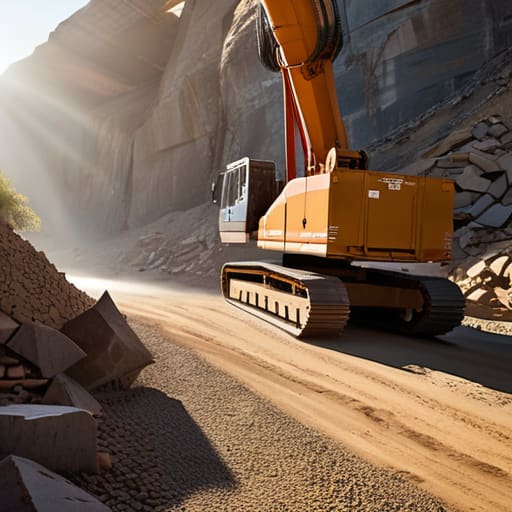
When I stand at the edge of an active pit, the air feels different—it’s heavy with the scent of pulverized dust and the vibration of something much larger than a human heartbeat. People often think of stone as something static, something eternal, but witnessing heavy equipment quarry operations reminds you that extraction is a violent, necessary rupture. There is a brutal rhythm to it: the mechanical scream of the drill biting into the bedrock, followed by the sudden, concussive shock of the blast. It isn’t just noise; it’s the sound of the earth being forced to yield its secrets.
I find myself watching the way the massive excavators move, almost like prehistoric beasts navigating a landscape of their own making. There is a strange, calculated choreography in the mineral extraction logistics required to move such immense volumes. You see the machines working in tight, dusty loops, pulling massive blocks from the face only to feed them into the maw of the primary crusher. It is a process of immense power, yet there is a meticulousness to it—a constant, driving need to balance the raw force of the machinery with the precise requirements of the final product. Even in this chaos, you can sense the gravity of the task: we are unmaking the mountain to build the city.
Where Mineral Extraction Logistics Meet the Masons Vision
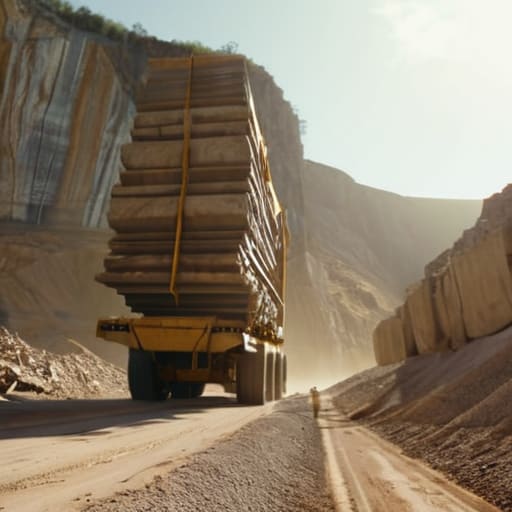
It is easy to view the movement of stone as a mere industrial necessity, a logistical hurdle to be cleared before the real art begins. But when I stand in the shadow of a rising cathedral, I don’t see a supply chain; I see a conversation between the earth and the architect. The mineral extraction logistics required to move a single monolithic column are not just about efficiency—they are about the physical limits of what a human can command from the landscape. Every block that arrives on site carries the weight of its journey, a silent testimony to the precise coordination required to bridge the gap between a raw mountain face and a finished pediment.
The architect’s vision is often constrained by what the terrain allows. I have spent many afternoons tracing the grain of travertine, realizing that the very dimensions of a courtyard were dictated months, perhaps years, earlier by the capacity of the bulk material hauling solutions available at the time. We often forget that the mason’s hand is guided by the quarryman’s cut. If the extraction was rushed or the transport methods too crude, the stone arrives fractured or undersized, forcing the builder to adapt. To me, the beauty lies in that tension: the moment where the raw, unyielding geometry of the quarry is finally tamed into the elegant, intentional lines of a floor plan.
The Weight of the Finished Wall
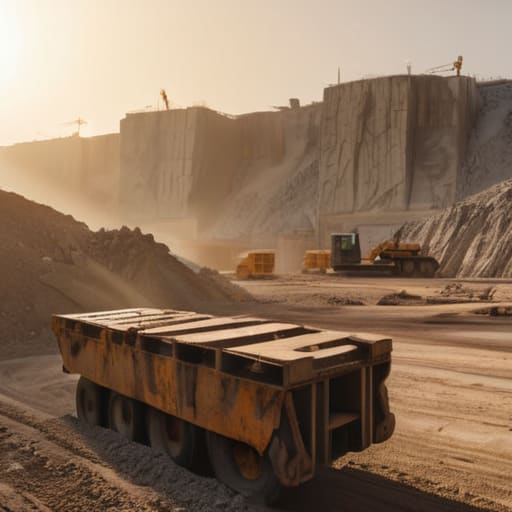
When we finally stand before a finished facade, it is easy to forget the sheer, grinding physics that brought it into being. We see the elegance of the arch, but we often overlook the brute force of the extraction and the calculated chaos of the transport routes. From the initial strike of the wedge in the quarry to the final, delicate placement by the mason, every block carries the memory of its journey. It is a sequence of violent transitions—from a mountain face to a heavy sled, and finally to a precise architectural element—that requires a seamless marriage between the raw power of logistics and the meticulous intent of the designer.
I find myself returning to these stones long after a project is finished, running my fingers over a particularly stubborn tool mark or a slight irregularity in the grain. These aren’t mistakes; they are the signatures of a struggle against gravity and time. Next time you walk through an old piazza or enter a cathedral, don’t just look at the scale of the monument. Look instead at the seams and the surfaces. If you listen closely to the way the stones meet, you will hear the echoes of the men who moved them, reminding us that every great structure is simply a triumph over the earth’s resistance.