I was kneeling in the dust of a crumbling sacristy in Syracuse last July, my fingers tracing the uneven grit of a lime-wash that had survived three centuries of humidity. Most people visit these sites to photograph the grand altarpiece or the sweeping arches, but I was staring at a single, misplaced wedge of travertine that had been jammed into a corner to stop a structural shift. It is in these tiny, frantic corrections—the moments where the original plan failed and a human hand had to improvise—that I find the rediscovery of perspective. We spend so much time looking at the finished, polished facade of our lives that we forget the structural reality of how we actually hold ourselves up.
I am not here to offer you some lofty, spiritualist retreat or a set of vague mindfulness exercises. Instead, I want to show you how to look at your own life the way I look at a weathered masonry joint: with a technical, unblinking eye for what is actually supporting the weight. We are going to stop obsessing over the aesthetic of the “perfect life” and start examining the mortar and the seams that keep us standing.
Table of Contents
Tracing the Fractures in Linear Perspective History
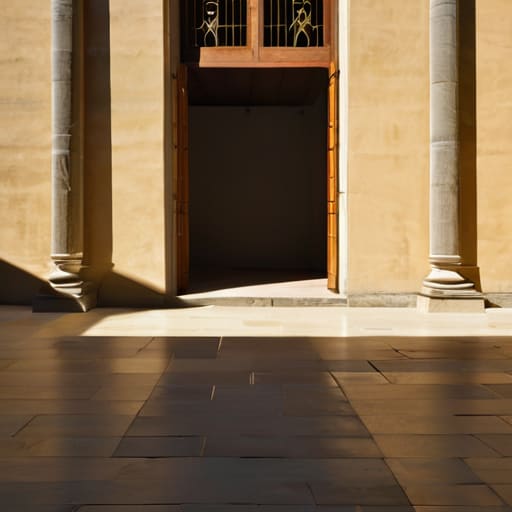
We often treat the arrival of the Renaissance as a sudden, clean rupture, a moment where the world simply snapped into focus. But when I am standing in a courtyard in Florence, tracing the way a cornice meets a pilaster, I see that the transition was far more jagged. The linear perspective history we teach in schools suggests a smooth, mathematical ascent, but the stones tell a different story of struggle. They show us the period when artists were desperately trying to reconcile the flat, symbolic truths of the Middle Ages with a new, hungry desire for artistic depth and dimension.
I often think of the Brunelleschi perspective discovery not as a quiet epiphany, but as a violent imposition of order upon chaos. He wasn’t just inventing a way to draw; he was forcing the eye to obey a grid. When you look at the early experiments with one-point perspective techniques, you can see the hesitation in the lines—the way a painter’s hand wavered before committing to a vanishing point that felt almost too rigid, too clinical. It was a battle between the intuitive way we actually perceive space and the cold, mathematical principles of drawing that sought to domesticate it. The fractures in that evolution are where the real human tension lives.
Where Brunelleschi Perspective Discovery Meets the Human Eye
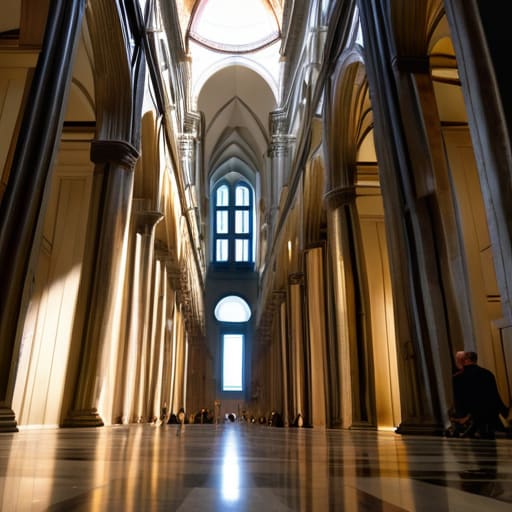
When I stand in the Duomo in Florence, I don’t just see the vastness of the nave; I see the invisible lines that hold it together. We often treat the Brunelleschi perspective discovery as a mere mathematical triumph, a clean triumph of geometry over chaos, but that is a sterile way to view it. To me, it feels more like an architectural intervention. Filippo wasn’t just calculating vanishing points; he was teaching the eye how to inhabit a space that had previously felt flat or overwhelming. He gave us the tools to reconcile the physical weight of stone with the ethereal lightness of visual spatial perception.
It is easy to get lost in the mathematical principles of drawing that define the era, but I find more truth in the tension between the grid and the actual material. When you look at a Renaissance fresco, you aren’t just seeing a window into another world; you are seeing a deliberate attempt to bridge the gap between the viewer’s pulse and the static permanence of the wall. Perspective isn’t just a trick of light; it is the intentional geometry of human presence, a way of saying that even in a world of infinite depth, we have a specific, unmovable place to stand.
The View Beyond the Vanishing Point
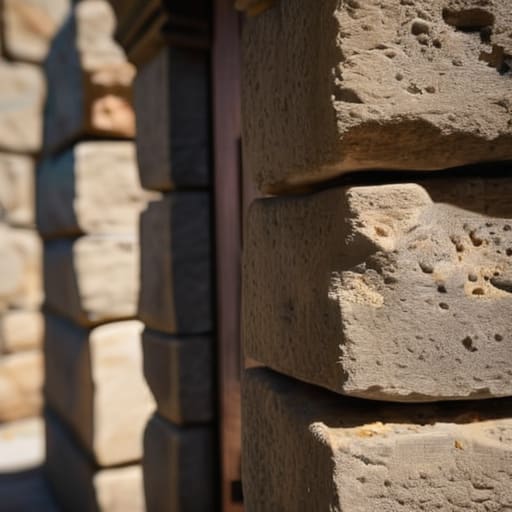
We have traveled from the rigid geometry of Brunelleschi’s experiments to the messy, beautiful reality of how the eye actually navigates a space. It is easy to get lost in the mathematics of a vanishing point, treating a building like a mere calculation on a page. But as we have seen, true perspective isn’t just about where parallel lines meet; it is about the tension between the mathematical ideal and the physical reality of a stone wall that has settled over four centuries. To understand a structure, we must stop looking through the lens of a perfect diagram and start looking at the way light actually hits a textured surface, or how a doorway was slightly skewed because the mason was working by eye rather than by a ruler.
Ultimately, rediscovering perspective means reclaiming our right to see the world as it is, not as a blueprint dictates it should be. When you walk through a courtyard in Ravenna or a chapel in Palermo, don’t just look at the grand scale of the arches. Look at the seams where the materials meet. Look for the slight irregularities that prove a human hand was involved in the making. If you train your eyes to find the story in the joints and the mortar, you will find that the world is far more profound, and far more intimate, than any single point of view could ever suggest.