
I was standing in a crumbling courtyard in the outskirts of Naples last Tuesday, watching a contractor try to patch a structural fissure with nothing but cheap, grey cement and a prayer. It’s the same way politicians approach the concept of peripheries and social issues: they treat the symptoms with a superficial layer of “urban renewal” paint, ignoring the fact that the very foundation is shifting. They talk about these areas as if they are abstract sociological problems to be solved on a whiteboard, but you can’t solve a crisis by ignoring the material reality of the streets where people actually live and breathe.
I am not here to give you a lecture on urban theory or a sanitized list of government initiatives. Instead, I want to show you how to read the decay. We are going to look at the cracks in the masonry and the poorly planned junctions of these neighborhoods to understand how structural neglect dictates the lives of those within them. I will show you that if you want to understand the true weight of our social failures, you have to stop looking at the maps and start looking at the joints and mortar of the cities we’ve allowed to break.
Table of Contents
Cracks in the Civic Mortar
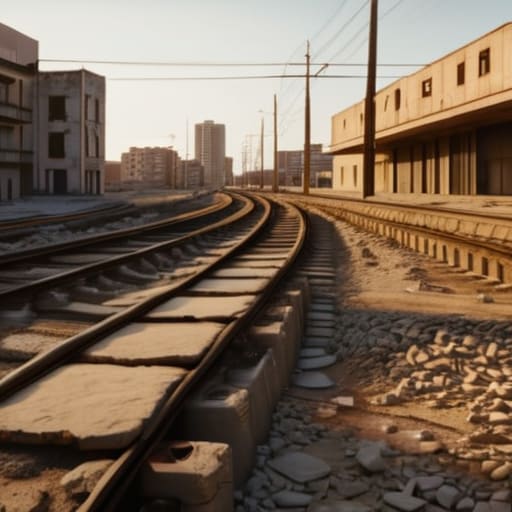
When I walk through the outskirts of Naples or the sprawling, unfinished blocks on the edges of Milan, I don’t just see broken concrete; I see a failure of intention. In my work, I look at how lime and sand bind a structure, but here, the binding agent is missing entirely. You can see the spatial injustice in urban planning in the way the transit lines simply stop, leaving these neighborhoods to drift into a kind of structural loneliness. It isn’t just a lack of aesthetic cohesion; it is a physical manifestation of how we decide who is worth the investment of a paved road or a reliable sewage line.
The decay isn’t always a sudden collapse; it’s often a slow, rhythmic erosion. I see it in the way the cheap, modern cladding on social housing projects begins to peel away from the structural core, much like the social exclusion in suburban fringes that leaves residents feeling untethered from the city’s heartbeat. When a community is denied the basic dignity of well-maintained public spaces, the architecture begins to reflect that neglect. The building doesn’t just stand there; it retreats, pulling its walls inward as if trying to protect itself from a city that has already turned its back.
Where the Blueprint Fails
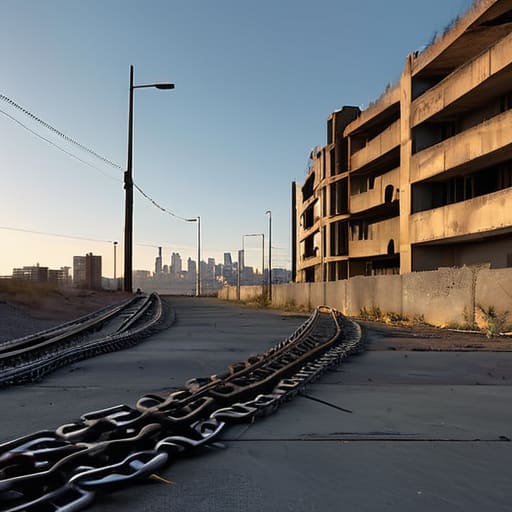
When I look at a site plan, I don’t just see lines and intended setbacks; I see the ghost of a decision made in a climate-controlled office miles away. A blueprint is a promise of order, but in the outskirts, that promise often feels like a hollow shell. You can see it in the way the transit lines simply stop, or how the public squares are designed as mere transit corridors rather than places to linger. This is where spatial injustice in urban planning becomes visible to the naked eye. It isn’t just a lack of aesthetics; it is a structural refusal to integrate these zones into the heartbeat of the city, leaving them to function as mere afterthoughts in a grander, more polished design.
The failure isn’t just in the geometry, but in the material reality of the inhabitants. When a neighborhood is designed without the connective tissue of schools, clinics, or reliable transport, you aren’t just looking at poor layout—you are witnessing social exclusion in suburban fringes rendered in concrete and asphalt. I’ve stood on the edge of many such developments, watching how the lack of fundamental infrastructure creates a physical barrier that no amount of fresh paint can fix. It is a profound, quiet violence, built into the very very foundations of how we choose to occupy space.
The View from the Ground
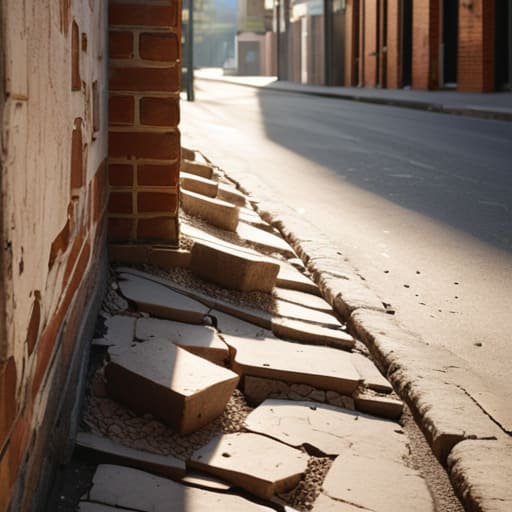
We cannot keep treating these peripheral zones as mere errors on a map or structural anomalies to be bypassed. As I have traced through the crumbling masonry and the poorly executed expansions of these neighborhoods, it becomes clear that the decay is not just physical; it is a symptom of a systemic lack of cohesion. When the mortar is too thin and the load-bearing elements are ignored, the entire structure begins to fail. We have seen how the lack of investment creates a feedback loop of neglect, where the very fabric of the city—the joints, the streets, the communal spaces—is allowed to erode until the social connection becomes as brittle as aged lime mortar.
Ultimately, my work has taught me that you don’t fix a building by simply painting over the cracks; you have to understand the weight it is carrying and the foundation it sits upon. If we want to heal our peripheries, we must stop looking at them as “problems” and start looking at them as living, breathing assemblies that require more than just a superficial patch job. We need to design for dignity, ensuring that every new brick laid and every street reclaimed serves to strengthen the whole. Because if we learn to respect the way a city is put together, we might finally learn how to hold its people together, too.